
Downtown Mason, Ohio: Rediscovering the Historic Heart of a Modern Suburb
Behind the corporate campuses and master-planned subdivisions lies Mason’s original 1815 village center — now undergoing revitalization through the Mason Mile initiative.
When drivers travel through northern Greater Cincinnati, Mason is easy to associate with major corporate headquarters, expansive subdivisions, regional shopping, and high-profile attractions like Kings Island and the Cincinnati Open. Yet nestled beneath this substantial suburban footprint lies something distinctly different: an original village center platted long before the advent of modern suburban development.
As the surrounding city grew rapidly over recent decades, Downtown Mason maintained its smaller physical scale along Main Street and Reading Road. Today, a coordinated public-private effort is exploring how that historic center can evolve to serve as an active civic and community anchor within the surrounding suburban ecosystem.
The Mason Before Modern Mason
Downtown Mason’s recorded history dates to June 1, 1803, when Revolutionary War veteran Major William Mason purchased 640 acres of land at auction for $1,700. In 1815, Major Mason platted sixteen initial lots on his property and named the settlement Palmira (later recorded as Palmyra).
To accommodate an east-west orientation for Main Street, Major Mason adjusted the roadway layout through town along today’s Route 42 corridor. In 1835, following postal confusion with another Ohio village named Palmyra, the town officially adopted the name Mason. For the next century and a half, Mason remained a quiet Warren County agricultural village — recording fewer than 5,700 residents as late as 1970 before its modern suburban growth accelerated.
A Different Physical Scale
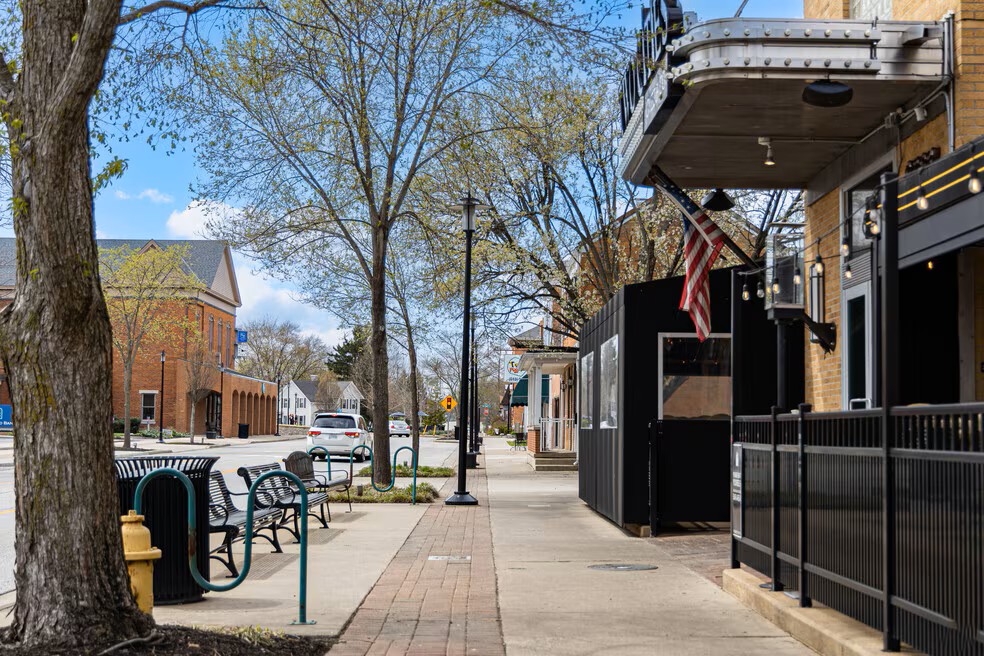
What immediately distinguishes Downtown Mason from the surrounding city is its physical proportion. While newer commercial corridors along Mason-Montgomery Road and Tylersville Road were built primarily for automobile convenience, Downtown Mason maintains a traditional block structure centered around pedestrian movement.
Older buildings, sidewalk-facing businesses, civic uses, mature trees, and the smaller street scale distinguish the historic center from Mason's newer commercial corridors. This human scale provides a distinct aesthetic contrast to the cul-de-sacs and office parks that characterize much of northern Warren County.
What Is the Mason Mile?
To strengthen and connect this historic center, the City of Mason, in partnership with MADE CDC and the MADE Chamber, launched the Mason Mile initiative. The Mason Mile encompasses a one-mile corridor stretching along Main Street from Reading Road through the historic core.
Following stakeholder input, the City Council adopted the Mason Mile Master Plan and updated downtown zoning codes. The master plan serves as a long-range framework to encourage mixed-use infill, preserve historic architecture, enhance streetscapes, improve pedestrian safety, and create dedicated public gathering spaces.
Bringing New Energy to an Older Center
Downtown Mason is an evolving district. Rather than attempting to re-create an artificial entertainment center, the revitalization strategy focuses on supporting local businesses, improving public spaces, and bringing recurring community events to the historic core.
Existing initiatives include completed streetscape enhancements, sidewalk repairs, an updated property maintenance framework, and community gatherings like the Mason Market on the Mile and the East Main Music Fest. Looking ahead, the master plan identifies future opportunities for boutique retail, local dining, outdoor gathering areas, and multi-unit residential infill designed to blend with the historic streetscape.
Old Mason Inside Modern Mason
Understanding Downtown Mason provides valuable perspective on the broader city. As explored in our analysis of Living in Mason, Ohio, the municipality functions as a complete suburban ecosystem containing major corporate campuses, public schools, and municipal sports complexes.
The historic core acts as an anchor within that ecosystem — offering locally owned dining, independent shops, older housing stock, and civic identity. For home buyers exploring Mason real estate, housing options near the historic center offer proximity to an older street network and ongoing public investment alongside the newer subdivision patterns more commonly associated with the city.
An Enduring Civic Anchor
Downtown Mason offers a visible connection to the community that existed long before today's corporate campuses, subdivisions, and regional attractions. The Mason Mile initiative adds another chapter to that story — one focused on how the historic center can adapt while retaining the smaller scale and civic identity that distinguish it from the rest of modern Mason.
Sources & Reference Materials:
- City of Mason History Records (imaginemason.org/about/history)
- MADE CDC — Downtown Mason Mile Master Plan & Zoning Information (madecdc.org/downtownmasonmile)
- Mason Historical Society Archives & Alverta Green Museum (masonhistoricalsociety.org)

About Chris
Chris Harris is an AI-Certified Agent™ with eXp Realty who has been helping buyers and sellers throughout Greater Cincinnati and Northern Kentucky for more than 25 years.
As publisher of Greater Cincy Homes and its editorial publication, Sweet Home Cincinnati, Chris shares local insights, neighborhood guides, market expertise, and practical advice designed to help people make confident real estate decisions—and love where they live!
Chris Harris | AI-Certified Agent™ | eXp Realty
📍 Serving Greater Cincinnati & Northern Kentucky
Helping you love where you live!