
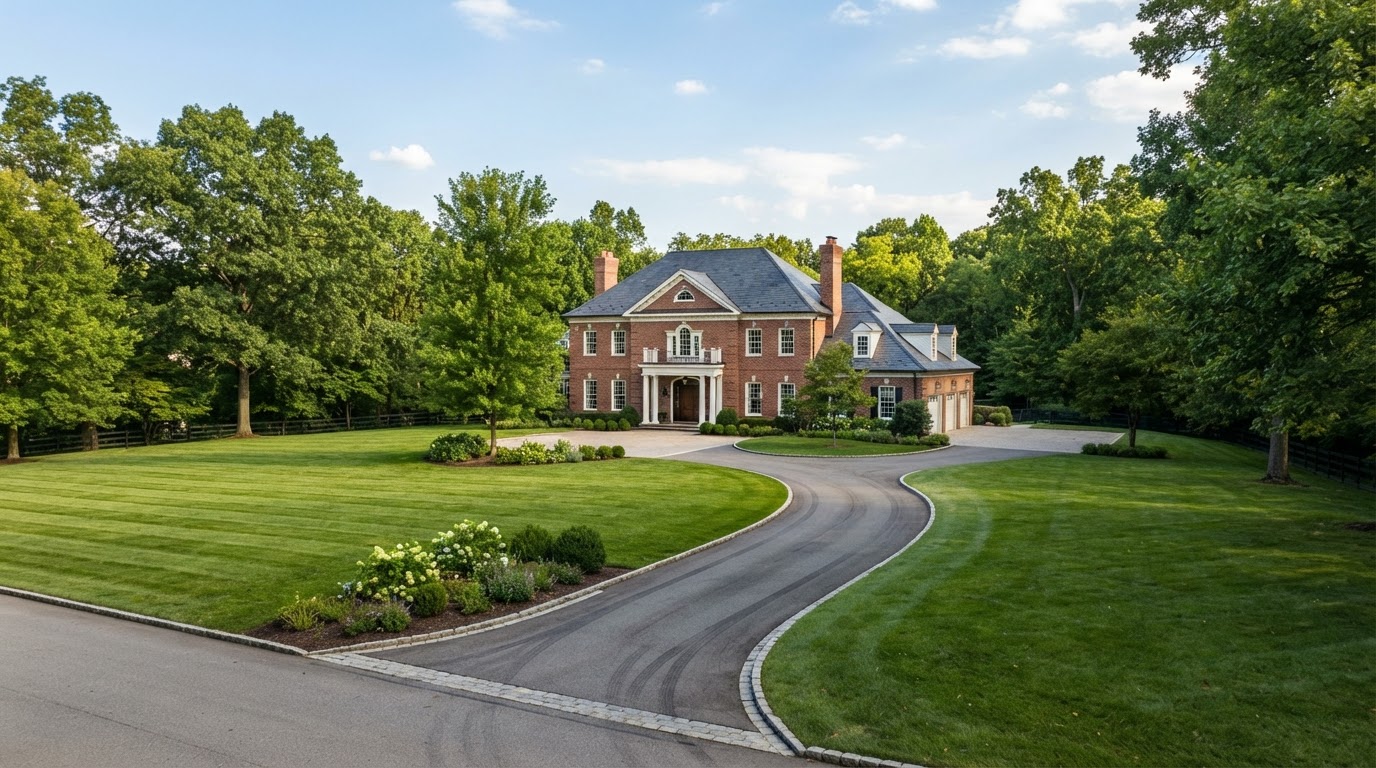
When buyers evaluate a home in a conventional suburban subdivision, the land is usually a fairly straightforward variable. Lots are largely uniform in size, utilities are uniformly public, and setbacks follow predictable patterns. In Indian Hill, however, the property and the land are central to the entire transaction.
As explored in our overview of what makes Indian Hill different as a village, the community's zoning framework enforces minimum lot sizes ranging from one to five acres across its residential districts. But understanding lot size is only the beginning. Topography, setbacks, mature vegetation, utility arrangements, easements, outbuildings, and municipal regulations mean that evaluating an Indian Hill property requires a broader perspective than evaluating a typical residence.
Zoning Districts and Lot Configuration
The Village of Indian Hill divides residential land into three primary zoning classifications: District A (minimum five acres), District B (minimum three acres), and District C (minimum one acre). These zoning minimums shape not only house placement but what can be added to the lot in the future.
When examining a property, buyers should look closely at how the acreage is configured. A five-acre parcel that is gently sloping and fully usable feels very different from a five-acre parcel with steep ravines, heavily wooded sections, or designated green-area easements. Frontage, setbacks, parcel depth, and usable buildable envelope determine where improvements — such as an addition, pool, tennis court, or detached structure — can legally and practically be placed.
Additionally, some properties border or contain easements for the Village's 75-mile bridle trail network or protected green areas. These easements preserve community green space and trail connectivity, but buyers should understand exactly where easement boundaries lie and what access rights or maintenance expectations attach to them.
Utilities and Property Infrastructure
In many suburban settings, buyers take public water and sewer connections for granted. In Indian Hill, utility arrangements can vary by location and property age, making infrastructure verification an important part of due diligence.
Water service in the village is supplied by the Indian Hill Water Works, which pumps groundwater from wells on the Little Miami aquifer and serves the village along with several adjacent communities. However, sewer infrastructure varies. While many portions of the village connect to public sanitary sewer lines operated by Metropolitan Sewer District (MSD) or municipal systems, other properties utilize private household sewage treatment systems (septic systems).
Where a property uses a private sewage treatment or septic system, buyers should verify the type of system serving that specific property and understand its age, condition, maintenance history, and any applicable inspection or operating requirements.
Grounds, Trees, and Landscape Maintenance
The mature tree canopy and rolling topography that give Indian Hill its park-like character are major assets, but they also represent ongoing property management. A multi-acre lot with extensive lawn, mature hardwoods, landscaped beds, and long paved drives requires a different maintenance plan than a standard residential lot.
Buyers should evaluate the health of significant trees near structures, the age and condition of long private driveways, stormwater drainage patterns across the terrain, and the condition of retaining walls or stone features. Drainage is particularly relevant on properties with varied elevation; understanding how rainwater moves across the land during heavy storms helps prevent future basement or erosion issues.
Outbuildings and Secondary Structures
Many Indian Hill properties include secondary structures such as detached garages, guest quarters, barns, pool houses, or equestrian facilities. While these structures add function and character, an existing outbuilding should not automatically be assumed to support whatever future use or alteration a buyer has in mind.
Buyers considering a particular use, renovation, expansion, or change to a secondary structure should verify applicable Village requirements before relying upon that intended use as part of their purchase decision.
Evaluating Older Estates and Renovation Potential
Indian Hill features architecture spanning nearly a century, from historic mid-century and pre-war country estates to modern custom builds. Buyers considering an older or historic residence should evaluate structural integrity, mechanical systems, roof age, insulation, and electrical capacity alongside cosmetic elements.
Renovating or expanding a residence in Indian Hill requires navigating Village zoning guidelines, architectural approvals where applicable, and lot-coverage restrictions. For buyers considering a major renovation or teardown/rebuild project, conducting early feasibility reviews regarding setback requirements, stormwater management, and environmental constraints helps set realistic timelines and budgets.
Property-Specific Due Diligence
Depending on the characteristics of the property, due diligence may extend beyond a standard home inspection. Potential areas for additional evaluation may include, as applicable:
- Property boundaries, acreage, setbacks, or easements
- Private sewage or septic systems
- Significant trees near structures or drives
- Drainage or stormwater conditions
- Retaining walls or significant slopes
- Structural conditions
- Unusual or complex mechanical systems
- Secondary structures
Qualified professionals such as surveyors, arborists, septic specialists, engineers, or other appropriate experts may be useful when the characteristics of the particular property warrant their involvement.
Chris's Perspective
Two Indian Hill homes with similar square footage and price can be very different purchases. The house matters, but so do the acreage, setting, infrastructure, improvements, and responsibilities that come with the property. That's why I would evaluate an Indian Hill home as a complete property — not simply compare it to another house by specifications or price per square foot.
If you are considering a purchase or sale in Indian Hill, reach out directly for a conversation about the property and your goals.
Sources
Village of Indian Hill official website (indianhill.gov) — zoning ordinance, Water Works, bridle trail regulations, planning and zoning department; Hamilton County Auditor and Recorder records; Hamilton County Public Health household sewage rules. All information deemed reliable but not guaranteed.