
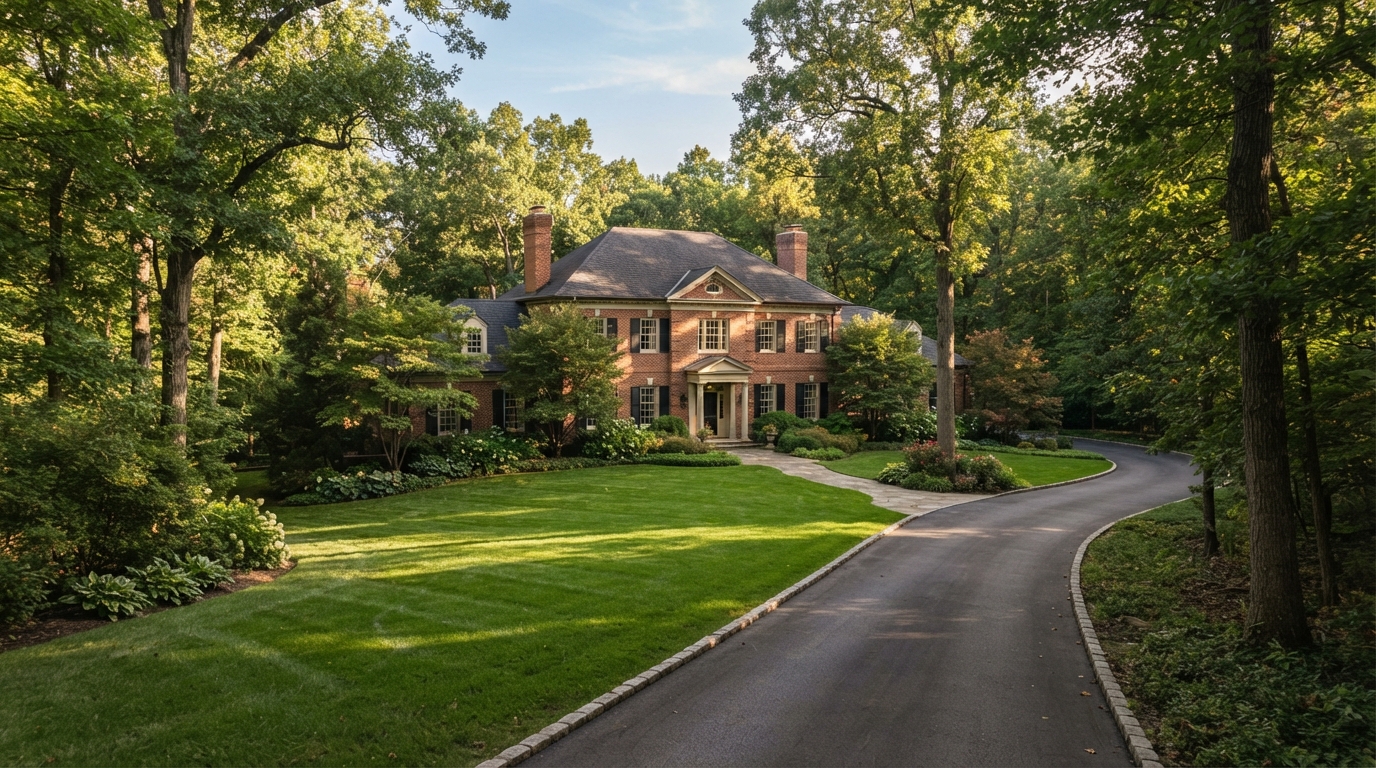
If you drive through Indian Hill for the first time, what strikes you is not the homes — it is the space between them. Mature trees line winding roads. Driveways disappear into the landscape. Homes sit far back from the street, often partially obscured by the canopy. The overall impression is less of a subdivision than of a preserved rural landscape that happens to contain some of Greater Cincinnati's most substantial residences.
That impression is not accidental. Indian Hill's character is the direct result of deliberate land-use decisions, zoning standards, and a civic commitment to preserving low-density residential development and green space. Understanding those decisions is the key to understanding what makes this community function differently — and what buyers should think about if they are considering living there.
A Village Built Around Space
The Village of Indian Hill encompasses approximately 19 square miles in northeastern Hamilton County. Despite that substantial land area, the population is relatively small — roughly 6,000 residents according to the 2020 census. That combination of large area and low population density is the foundation of everything that follows.
Indian Hill's residential zoning is organized into districts with meaningful minimum lot sizes. According to the Village's zoning ordinance, District A requires a minimum lot size of five acres, District B requires three acres, and District C requires one acre. These are baselines, not suggestions — they are enforced through the Village's planning and permitting process. The result is a community where even the smallest residential lots are substantially larger than those in conventional suburban subdivisions, and where the largest properties encompass significant acreage.
This is not simply a matter of large yards. The lot-size requirements shape the entire visual and environmental character of the village. They create natural spacing between homes, preserve wooded areas, and limit the number of houses that can be built on any given parcel. The effect is cumulative: when an entire community is built around multi-acre lots, the result feels fundamentally different from a community built around quarter-acre lots, regardless of the quality of the individual homes.
Privacy Is Built Into the Landscape
In many communities, privacy is something homeowners create through fencing, landscaping, or setback choices. In Indian Hill, privacy is largely a function of the land-use pattern itself. Homes set back from the road, separated by acreage and mature trees, naturally create a degree of visual separation that is difficult to replicate in a denser setting.
This does not mean every Indian Hill property is invisible from the street, or that every homeowner values privacy equally. But the physical structure of the village — large lots, wooded settings, winding roads, and substantial setbacks — means that privacy is the default condition rather than something that must be engineered after the fact.
The Bridle Trails and Green Space
One of Indian Hill's most distinctive amenities is its trail system. The Village maintains approximately 75 miles of bridle trails that wind through green areas, protected easements, and private lands. These trails are a genuinely unusual civic asset — not a paved walking path in a park, but an extensive network designed for equestrian and pedestrian use that connects different parts of the village.
The Village also maintains multiple parks, playgrounds, tennis and pickleball courts, and recreational facilities. The combination of bridle trails, green space, and low-density development means that the outdoor environment is central to the experience of living in Indian Hill in a way that goes beyond conventional park amenities.
Limited Commercial Development Shapes Daily Life
Indian Hill's zoning is overwhelmingly residential. The village does not have the commercial corridors, shopping districts, or restaurant clusters found in more densely developed communities. This reflects Indian Hill's long-standing residential land-use pattern, and it has practical consequences for how residents experience daily life.
Dining, shopping, and professional services are not absent from the area — they are simply located in nearby communities. Madeira, Montgomery, and Mariemont are all nearby and offer restaurants, retail, and services. The trade-off is structural: Indian Hill residents get a quieter, lower-density residential environment, but they drive to neighboring communities for most commercial activity.
This is neither inherently better nor worse than a more self-contained community. It is a different pattern of living. A buyer who values walkability to restaurants and shops may find Indian Hill's character less appealing, while a buyer who values privacy, land, and a quiet residential setting may find it ideal.
Architecture and Housing Variety
Indian Hill's housing stock is more varied than the "estate" label suggests. The village contains a range of architectural styles and eras, including traditional Georgian and brick residences, contemporary homes, and newer construction. Some properties are historic; others are relatively recent. Lot sizes and settings vary significantly across the three residential zoning districts.
What unites them is not a single architectural style but the context: substantial land, mature landscaping, and the spacing that the zoning framework requires. A buyer evaluating Indian Hill is often evaluating the property and the land together — the setting is inseparable from the home.
Indian Hill is also an important part of Greater Cincinnati's broader luxury housing market. But not every Indian Hill property is an estate, and buyers will find meaningful differences in lot size, architectural style, setting, and price point throughout the village.
Location Within Greater Cincinnati
Indian Hill is located in northeastern Hamilton County, with access to major employment centers in Cincinnati, Blue Ash, and the broader I-71 corridor. The village is close enough to Downtown Cincinnati and the region's cultural amenities to be practical, but far enough out to maintain its low-density character. For buyers who work in Cincinnati's eastern or northern suburbs, the commute can be relatively manageable. For buyers who need to be Downtown daily, the distance is more significant.
What Buyers Should Understand
Evaluating a home in Indian Hill is different from evaluating a home in a conventional subdivision. The land, the setting, the zoning framework, and the relationship between the property and the surrounding landscape all matter in ways that go beyond square footage and interior finishes.
Buyers should consider what the property's acreage actually requires in terms of maintenance, whether the setting aligns with how they want to live day to day, and how the specific lot, location within the village, and architectural character compare to other available options. A home on five acres is a different ownership experience from a home on one acre, even within the same community.
Buyers for whom school enrollment is important should review current information from the Indian Hill Exempted Village School District and the Ohio Department of Education and Workforce, including attendance boundaries and program details, since school assignments and family priorities vary.
Chris's Perspective
The most distinctive thing about Indian Hill is not the price of the homes — it is the land-use framework that makes those homes possible. When you are evaluating a property here, you are evaluating the land, the setting, and the village's civic character as much as the house itself. Two properties with similar square footage can offer entirely different ownership experiences depending on lot size, topography, privacy, and how the home relates to its surroundings.
If you are considering a purchase or sale in Indian Hill, reach out directly for a conversation about the property and your goals.
Sources
Village of Indian Hill official website (indianhill.gov) — zoning ordinance, planning documents, bridle trails, parks; U.S. Census Bureau — 2020 population and land area; Indian Hill Exempted Village School District (indianhillschools.org). All information deemed reliable but not guaranteed.