
Buying New Construction in Greater Cincinnati? What Buyers Should Know Before Visiting a Builder
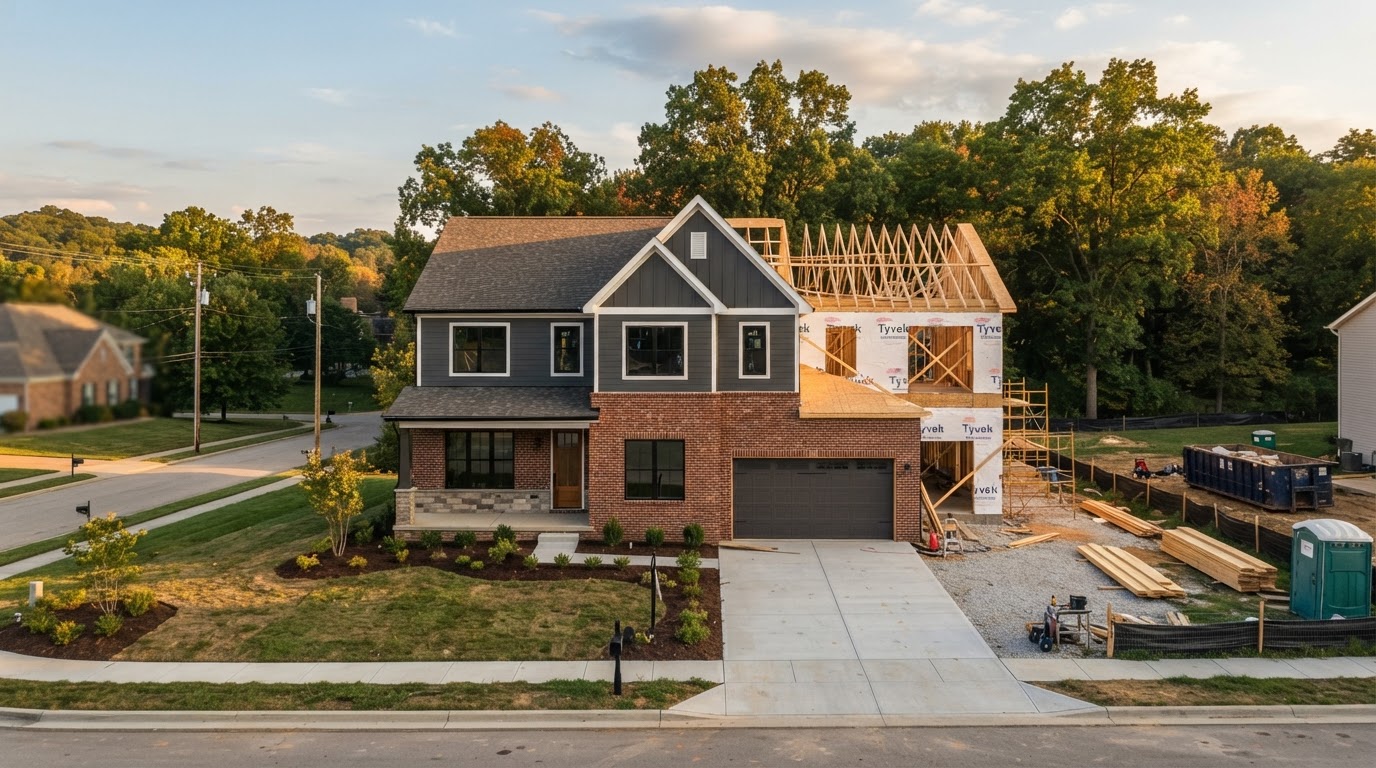
New construction gives Greater Cincinnati and Northern Kentucky buyers another path to homeownership, from suburban developments to infill opportunities and quick-move-in homes.
But buying new construction is not the same as buying a resale home. The process, the contracts, the pricing structure, and the timeline all work differently. And some of the most important decisions — about representation, financing, and timing — should be made before you set foot in a model home.
Here is what experienced buyers understand before they begin.
What "New Construction" Actually Means
New construction is not a single product. It can mean several different purchasing situations, and the process varies for each:
- To-be-built homes are purchased before construction begins. You select the floor plan, lot, and options, and the home is built to your specifications over the coming months.
- Homes under construction are already being built but have not yet been completed. Some selections may already be locked in, while others may still be available.
- Completed or quick-move-in homes (sometimes called spec homes) are finished or nearly finished. They offer faster timelines but less customization.
Each path involves different timing, flexibility, and decision points. Understanding which one you are entering helps set realistic expectations.
Why Buyers Think About Representation Before Visiting Builders
When you walk into a builder's model home, the person who greets you is the builder's sales representative. They are knowledgeable about the community, the floor plans, the available options, and the construction process. They can be genuinely helpful.
But they represent the builder — not you.
Their role is to sell the builder's homes at the builder's terms. They are not your advocate in negotiations, and they are not responsible for protecting your interests in the contract, the construction process, or the final walkthrough.
Many buyers choose to work with their own real estate agent when purchasing new construction. A buyer's agent can help you compare options, understand the transaction process, coordinate important milestones, and advocate for your interests while encouraging appropriate legal, lending, and inspection guidance when needed.
If you want your own agent involved, establish that relationship before you begin visiting builders.
Builder policies regarding agent registration vary. Many builders require your agent to accompany you on your first visit or to register with the builder in advance for the agent to be eligible for compensation. Some builders are more flexible. The important point is that builder policies are not universal, and waiting until after you have already registered or toured can complicate — though not necessarily eliminate — your ability to have your agent involved.
The simplest approach: if you plan to work with an agent, let the builder know at your first visit and understand that builder's specific registration policy.
Is the Advertised Base Price the Price You Actually Pay?
The starting price you see advertised online or on a yard sign typically reflects the base floor plan on a standard lot with builder-grade finishes and minimal options included.
The home you actually want may cost substantially more once you account for:
- Lot premiums — larger lots, corner lots, walkout basements, or premium locations within the community
- Structural options — additional garage bays, finished basements, extended patios, bonus rooms
- Design center selections — upgraded flooring, cabinetry, countertops, lighting, and plumbing fixtures
- Appliances — refrigerators, washers, and dryers are not always included
- Landscaping — fencing, trees, irrigation, and outdoor living features
- Window treatments — blinds, shades, and drapery are frequently the buyer's responsibility
- Closing costs — which may or may not be included in builder incentive packages
None of this means new construction is a poor value. It means the advertised starting price and the final purchase price are often two very different numbers. Understanding that gap before you fall in love with a floor plan helps you make decisions with your actual budget in mind.
If you are exploring new construction options across Greater Cincinnati and Northern Kentucky, you can browse available new construction homes to get a sense of current pricing and communities.
Builder Incentives and Preferred Lenders
Builders frequently offer incentives — closing-cost credits, rate buydowns, upgrade credits, or design allowances — to attract buyers. These incentives can be genuinely valuable, sometimes amounting to thousands of dollars.
In many cases, the full incentive is tied to using the builder's preferred or affiliated lender. That does not automatically make it a bad deal, but it does mean the incentive should be evaluated as part of the complete financing package, not in isolation.
A closing-cost credit from the builder's lender may look attractive, but if the interest rate or fees are higher than what an independent lender would offer, the upfront savings could be offset by higher monthly payments over the life of the loan.
The practical approach: buyers may want to compare the builder's preferred financing package with other available lending options, looking at the complete picture — including rate, fees, monthly payment, and incentive value — rather than evaluating the incentive alone.
This is not lending advice. It is simply the principle that an incentive is only as good as the overall financing package it is attached to.
Builder Contracts Are Not Standard Resale Contracts
Builder purchase agreements are typically drafted by the builder's attorneys and written to protect the builder's interests. They often differ significantly from the standard resale contracts used in Ohio and Kentucky real estate transactions.
Areas where builder contracts may differ include:
- Deposit structure — amounts, timing, and whether deposits are refundable
- Financing deadlines — what happens if financing falls through
- Construction timelines — whether completion dates are firm or estimated
- Change orders — how modifications are handled and priced after the contract is signed
- Contingencies — whether the contract is contingent on selling your current home
- Completion provisions — what constitutes substantial completion and your rights if the home is not ready on time
- Default provisions — what happens if either party fails to perform
- Warranties — what the builder covers and for how long
This is not legal advice. Builder contracts can be lengthy and complex, and the implications of specific provisions may not be obvious. If you have questions about contract terms, consider consulting a real estate attorney who can review the agreement and explain how it affects your specific situation.
Construction Timelines Can Change
For to-be-built homes, the construction timeline is typically an estimate, not a guarantee. Completion dates can shift due to weather, permitting delays, inspection scheduling, material availability, labor shortages, utility installation, and the sequencing of construction phases.
This matters because your financing, your current living situation, and potentially the sale of your existing home may all be tied to that timeline. A delay of several weeks or even months is not unusual, and it can create ripple effects across your entire housing plan.
Ask the builder how they communicate construction progress, what their typical timeline has been for recent completions, and how delays have been handled in practice. Then build flexibility into your own planning.
Inspections Matter — Even for Brand-New Homes
There is a common assumption that new construction does not need an independent inspection because the home has already passed municipal code inspections. That assumption can be costly.
Municipal inspections verify compliance with building codes. They are important, but they are not the same as an independent inspection performed on behalf of the buyer. Code compliance is a minimum standard, not a guarantee of quality workmanship.
Buyers sometimes consider independent inspections at stages such as:
- Pre-drywall inspection — when permitted and appropriately timed, may allow an independent inspector to observe framing, plumbing, electrical, and HVAC components that will later be concealed by drywall.
- Near completion or final walkthrough — an inspection shortly before closing can examine the finished product for defects, incomplete work, and items that need correction.
- Before warranty expiration — some buyers schedule an inspection near the end of an applicable builder warranty period to identify issues that may have developed after move-in.
Builder policies vary, contract provisions vary, construction schedules vary, and inspection access may vary. Buyers should determine what their specific contract and builder permit before scheduling any inspection.
Understand the Warranty Before You Need It
New homes commonly include some form of builder warranty, but the terms, duration, and coverage vary significantly by builder, warranty provider, home, and contract.
Before closing, obtain the actual warranty document — not a summary — and understand what is covered, what is excluded, how long different coverage lasts, required maintenance responsibilities, how claims must be submitted, and applicable deadlines. If the warranty is administered by a third-party company rather than the builder directly, understand who is responsible for responding to issues.
Choosing the Lot Matters More Than Buyers Expect
The homesite you choose affects your daily experience, your privacy, and your future resale value. Buyers sometimes focus on the floor plan and treat the lot as an afterthought, but the lot is the one thing about the home that cannot be changed later.
Considerations worth thinking through include:
- Orientation — how sunlight enters the home throughout the day and across seasons
- Topography — flat vs. sloped lots, walkout potential, drainage patterns
- Proximity to community entrances, amenities, or common areas — convenience vs. traffic or noise
- Future phases — whether your view, privacy, or street will change as the development continues
- Easements and utilities — where underground lines run and what restrictions apply
- Lot premiums — what additional features or location characteristics the premium provides and whether those benefits are worth the added cost to you
Ask the builder for a site plan showing your lot in relation to the surrounding community, and ask what is planned for adjacent or nearby parcels.
HOA and Community Considerations
Many new-construction communities in Greater Cincinnati and Northern Kentucky are governed by a homeowners' association. Not all are — but when an HOA exists, its rules and financial structure become part of your ownership experience.
Before purchasing, review the HOA documents, including the declaration, bylaws, and rules. Understand the monthly or annual assessment, what it covers, architectural restrictions that may affect future changes to your property, and whether the association is currently controlled by the developer or by the homeowners.
Developer-controlled associations function differently from homeowner-controlled ones. Understanding when and how control transitions can matter for years to come.
Coordinating the Sale of Your Current Home
For many buyers, purchasing new construction is not an isolated transaction. It is one half of a two-part move: selling the current home and buying the next one.
Some buyers have the financial flexibility to purchase before selling. They can carry both properties temporarily or purchase with cash, which gives them maximum flexibility in negotiating with the builder. This approach is not available to everyone, and it carries its own risks — including the cost of maintaining two properties and the uncertainty of selling the existing home on a timeline.
Other buyers need the proceeds from their current home to purchase the next one. In that case, the transactions need to be coordinated carefully. Construction delays can create problems if your current home has already sold or your rate lock is about to expire. Some builders accept contingent offers — offers that depend on the sale of your existing home — but not all do, and contingency terms vary.
The key is to think about both transactions as a single coordinated plan rather than two separate events. If you are also selling a home, you can explore your selling options to understand how the timing might work.
New Construction vs. Resale
New construction is not automatically better or worse than a resale home. The right choice depends on what matters most to you.
New construction offers customization, modern systems, current building codes, and the experience of being the first owner. Resale homes may offer established neighborhoods, mature landscaping, architectural character, faster timelines, and locations that new construction cannot replicate.
The tradeoff is not just about price. It is about timing, location, lifestyle, and how much customization matters to you. Both paths can lead to an excellent home — they simply require different approaches.
Chris's Perspective
Buying new construction works best when the major decisions are considered together — representation, financing, the builder contract, construction timing, inspections, your current home, and the eventual move. Asking the right questions early makes it much easier to evaluate the tradeoffs before you're emotionally committed to a particular home or homesite.
If you are considering new construction in Greater Cincinnati or Northern Kentucky, you can explore available new construction homes or set up custom home alerts tailored to your search.
Frequently Asked Questions
Sources & Further Reading
- Zillow Research, Consumer Housing Trends Report — new construction buyer behavior and agent usage
- National Mortgage Professional, "Games Builders Play… And How to Beat Them" — builder incentive structures and preferred lender dynamics
- Inspectify, "Everything You Need to Know About New Construction Phase Inspections" — pre-drywall and final inspection practices

About Chris
Chris Harris is an AI-Certified Agent™ with eXp Realty who has been helping buyers and sellers throughout Greater Cincinnati and Northern Kentucky for more than 25 years.
As publisher of Greater Cincy Homes and its editorial publication, Sweet Home Cincinnati, Chris shares local insights, neighborhood guides, market expertise, and practical advice designed to help people make confident real estate decisions—and love where they live!
Chris Harris | AI-Certified Agent™ | eXp Realty
📍 Serving Greater Cincinnati & Northern Kentucky
Helping you love where you live!