
When people talk about Indian Hill, conversation usually begins with real estate — lot sizes, setbacks, and architectural variety. As we explored when looking at what makes Indian Hill different as a village and how to evaluate its individual properties, land is central to the residential experience here.
Yet if you spend time in the village beyond looking at houses, you quickly discover that Indian Hill's relationship with land is not merely private. It is active, communal, and experiential. Working organic farms, educational foundations, an extensive bridle-trail network, and long-standing equestrian traditions give Indian Hill a rural, grounded character that remains unusually visible within Greater Cincinnati.
Turner Farm: Where Agriculture Meets Community
At the corner of Given and Shawnee Run Roads sits Turner Farm, one of the oldest working organic farms in Southwest Ohio. Covering more than 200 acres, the farm produces certified organic vegetables, pasture-raised meats, flowers, and herbs using sustainable and regenerative agricultural practices.
Because Indian Hill's low-density residential development and large parcels can make much of the village feel quiet and private from the road, Turner Farm creates a different kind of connection to Indian Hill: an invitation in. Through its Teaching Kitchen, hands-on workshops, agricultural education, farm camps, and seasonal programming, it connects visitors directly with sustainable farming and food production.
The Turner Farm Market offers fresh seasonal produce, pasture-raised meats, eggs, and local artisan foods directly to the public.
One of the things I particularly appreciate about Turner Farm is the way it shares its mission with the broader community. Through food, education, classes, and the Farm Market, the farm gives people a tangible way to connect with the land and think more intentionally about where their food comes from. And the Farm Market offers perhaps the simplest connection of all — a chance to bring a little of the farm home with you.
Greenacres Foundation: Preservation, Education & Stewardship
Another cornerstone of Indian Hill's land heritage is the Greenacres Foundation. Established in 1988 by Louis and Louise Nippert, Greenacres was founded to preserve green space, educate children and adults about agriculture and the environment, and encourage appreciation for music and the arts.
In Indian Hill, Greenacres stewards hundreds of acres of rolling pasture, farmland, and woodland. Its agricultural operations emphasize regenerative agriculture, soil health, and humane animal husbandry. The foundation hosts educational school field trips, equine programs, agricultural research, and community events that encourage environmental stewardship.
Together, Turner Farm and Greenacres keep agriculture, conservation, and land stewardship visible parts of Indian Hill's contemporary landscape.
The 75-Mile Bridle Trail Network
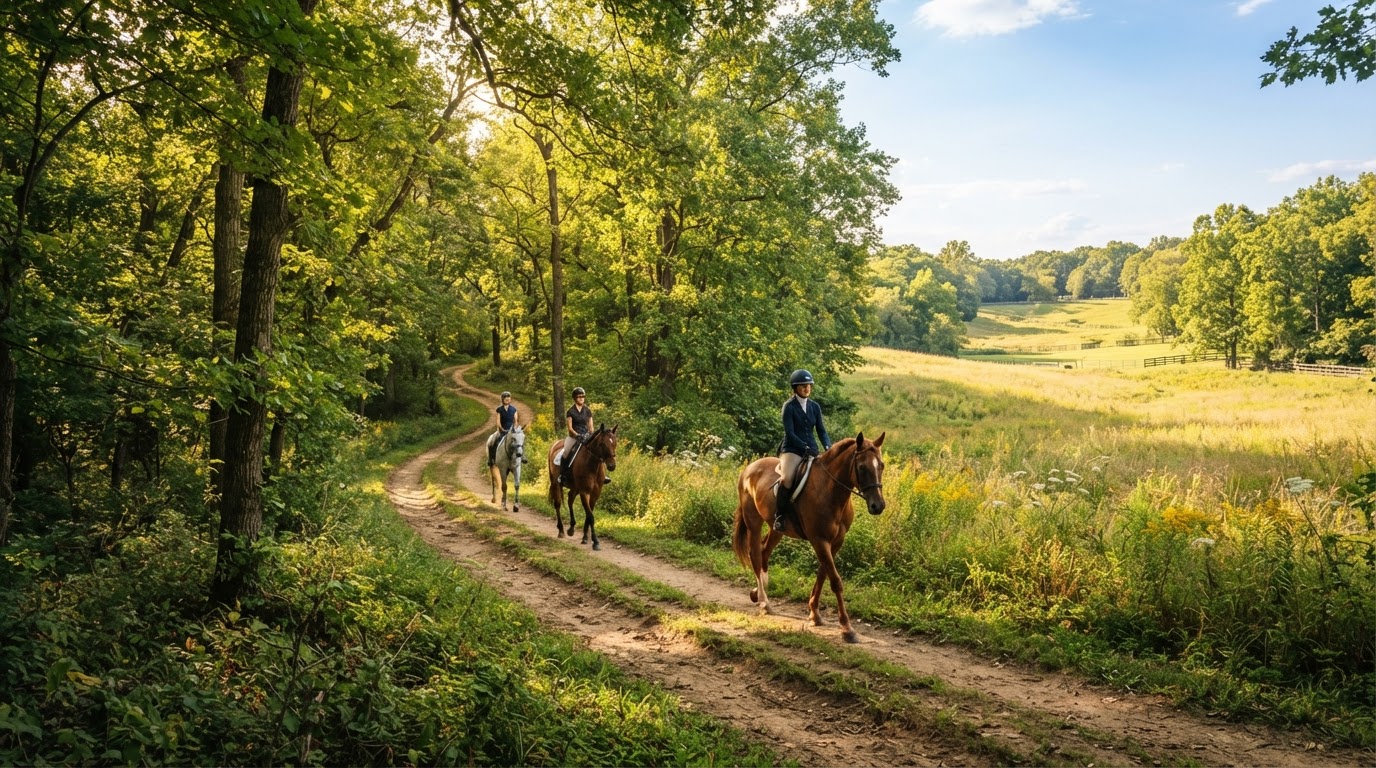
Perhaps the most distinctive physical feature of Indian Hill's outdoor landscape is its 75-mile bridle trail network. Threading through wooded ravines, along stream corridors, across meadows, and alongside quiet country roads, the trail network connects large portions of the village.
The Village of Indian Hill Public Works Department maintains the trail network, performing routine seasonal work such as mowing, weed-eating, and tree trimming, along with culvert replacements, sign installation, drainage projects, re-routing, and new trail installation as needed. Many segments of the network cross private property through recorded easements granted by individual landowners, while other portions traverse municipal Green Areas.
Because much of the network crosses private land, trail use is regulated by the Village. A bridle trail license is required to ride on the Indian Hill trails, with separate fee schedules for residents and non-residents, and guests of licensed riders can obtain daily passes. This licensing system helps the Village balance trail access with landowner privacy and maintenance needs.
Equestrian Traditions: From the Camargo Hunt to the Equestrian Club
Indian Hill's trail system was not created by accident. It developed directly out of the village's deep equestrian history.
Indian Hill's equestrian tradition took shape in the 1920s. According to records maintained by the Indian Hill Historical Society, the Camargo Hunt was established in 1925, receiving official recognition from the Masters of Foxhounds Association three years later.
Early residents cleared continuous trails across miles of forested terrain and neighboring farms to ride. Between 1930 and the early 1950s, foxhunting flourished across some 50 square miles of country. As suburban growth gradually fragmented contiguous open land in later decades, the Camargo Hunt eventually relocated its active hunting grounds to Clermont County in 1973 and later to Northern Kentucky, where expansive terrain remained available.
However, the physical trails created during that era remained. Today, organizations like the Indian Hill Equestrian Club — an all-volunteer non-profit with more than 100 members — help carry that heritage forward. The club organizes monthly trail rides, educational events on equine health and pasture management, trail maintenance support, and community participation in local traditions like the village 4th of July parade.
A Shared Responsibility to the Landscape
Taken together, Turner Farm, Greenacres, the bridle trails, and Indian Hill's equestrian traditions reveal something important about the village: the land here is more than the setting for its homes. It is still farmed, preserved, studied, traveled, and cared for.
You can see that connection in many ways — in produce from the Farm Market, horses moving along a wooded trail, open pasture along Given Road, or land protected for future generations. Looking beyond the houses reveals another side of Indian Hill, one in which the landscape itself remains an active part of the community's story.
Sources & Further Reading
Turner Farm official site (turnerfarm.org); Greenacres Foundation (green-acres.org); Indian Hill Equestrian Club (ihequestrian.com); Indian Hill Historical Society — Camargo Hunt archives (indianhill.org); Village of Indian Hill official website (indianhill.gov) — bridle trail regulations and Green Areas trust information. All information deemed reliable but not guaranteed.